|
The Centre has consistently made efforts to maintain normalcy in the state - be it the political front, the economic sphere or to stem the problem of infiltration and militancy.
Armed tribesmen from Pakistan's North-West Frontier Province attacked Kashmir in October 1947. Besieged both by a revolt in his state and by the invasion, Maharaja Hari Singh of Jammu and Kashmir, signed the instrument of accession and decided to join India
Maharaja requested armed assistance from the government of India. In return he acceded to India, handing over powers of defense, communication and foreign affairs.
The Delhi Agreement, 1952
The main features of this agreement were that in view of the decision taken up by the state assembly that sovereignty in all matters other than those specified in the Instrument of Accession continues to reside in the State. It was agreed between the two governments that in accordance with Article 5 of the Indian Constitution, persons who have their domicile in Jammu and Kashmir shall be regarded as citizens of India, but the state legislature was given power to make laws for conferring special rights and privileges on the 'state subjects'.
The Union Government agreed that Jammu and Kashmir should have its own flag in addition to the Union flag.
There was complete agreement with regard to the position of the Sadar-i-Riyasat; though the Sadar-i-Riyasat was to be elected by the state assembly.
There was a great deal of discussion with regard to the "Emergency Powers"; the Government of India insisted on the application of Article 352, empowering the President to proclaim a general emergency in the state.
In 1954 Jammu and Kashmir's accession to India was ratified by the state's constituent assembly.
Article 370
Jammu and Kashmir is the only state in India that enjoys special status under Article 370. This means that no law endorsed by the Parliament, except from those in the field of defence, foreign policy and communication, will be enforced in the state unless it is ratified by the state assembly.
The 1965 war
India and Pakistan fought a war in 1965. Pakistan launched an offensive across the ceasefire line into Jammu and Kashmir. India retaliated by crossing the international border at Lahore. After three weeks, both India and Pakistan agreed to a UN-sponsored ceasefire.
Tashkent declaration
India and Pakistan signed this declaration on January 10, 1966. According to this declaration it was decided that normal and peaceful relations will be maintained by the two nations.
It was decided that both sides would exert all efforts to create good neighbourly relations in accordance with the United Nations Charter that stated not to recourse to force and to settle their disputes through peaceful means.
The 1971 war
Relations hit a new low again when civil war erupted in Pakistan, pitting the West Pakistan army against East Pakistanis demanding autonomy and later independence.
In December, India invaded East Pakistan in support of the East Pakistani people. The Pakistani army surrendered at Dhaka and East Pakistan became the independent country of Bangladesh on December 6, 1971.
Shimla Agreement
Tensions were reduced by the Simla accord of 1972 and by Pakistan's recognition of Bangladesh in 1974. The Simla accord committed both sides to abide by the principles and purposes of the Charter of the United Nations that shall govern the relations between the two countries.
The two countries decided to resolve their differences by peaceful means through bilateral negotiations or by any other peaceful means mutually agreed upon between them.
In relation to Jammu and Kashmir, the two countries agreed upon the ceasefire line, which was renamed the Line of Control.
Kargil conflict
In May 1999, India launched air strikes as Pakistani-backed forces infiltrated into north Kargil. However, Pakistan denied this infiltration.
Pakistan insisted instead that the forces were "freedom fighters" fighting for the liberation of Jammu and Kashmir.
Under pressure from the United States, Prime Minister Nawaz Sharif called upon its Army to withdraw from Kargil.
Amarnath land row
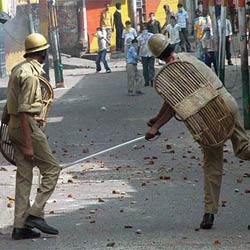
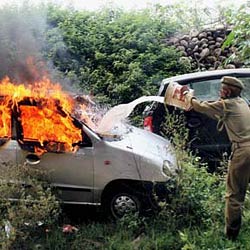
This problem began in May this year when the government of Jammu and Kashmir ordered the transfer of approximately 40 acres of forest land to the Shri Amaranth Shrine Board for the construction of shelters for the Amarnath yatris. This order sparked violent protests in Kashmir Valley as well in Jammu region separately. |